
M1 BIP – SCIENCES DU VEGETAL / PLANT SCIENCES program
Candidater au M1 (17 Février au 17 Mars 2026) : à savoir
>Pré-requis :
Bonnes connaissances de Licence 3 (ou équivalent) en Physiologie végétale, biologie moléculaire, génétique, génomique et biologie cellulaire.
Bases solides de statistiques et d’anglais (niveau B2).
Projet professionnel et parcours en cohérence avec la formation
Comment ? en ligne sur la plateforme nationale MON MASTER . du 24 Février au 25 Mars 2025
Composition du dossier de candidature :
documents demandés par la plateforme + documents spécifique de la formation (cf site Mon master)
Procédure du recrutement :
Suite à l’examen et une pré-sélection des dossiers, un entretien de motivation sera réalisé (en visioconférence à priori).
Notes importantes :
SI vous résidez dans un pays relevant de la procédure “Etudes en France” vous devez faire une demande spécifique d’inscription via la plateforme dédiée sur le site de Campus France avant fin Fevrier : campusfrance-procedure-cef
Les enseignements de M1 étant dispensés essentiellement en langue française, les candidats non-francophones doivent pouvoir justifier d’un niveau de français au movalent au niveau B2 défini par le Cadre Européen Commun de Référence pour les langues (CECR).
Flyer-Master Sciences du Végétal-Université Paris Cité
Plant Science master-Université Paris Cité-flyer
flyer_english-masterBIP-Plant SciencesYour content goes here. Edit or remove this text inline or in the module Content settings. You can also style every aspect of this content in the module Design settings and even apply custom CSS to this text in the module Advanced settings.
All about the master: videos from students
PRESENTATION GENERALE DU M1
Le fonctionnement et le développement des végétaux, leurs réponses à l’environnement ou encore leurs interactions avec d’autres organismes vous passionnent ? Vous souhaiteriez travailler dans le domaine de la recherche fondamentale ou appliquée, mais pourquoi pas aussi dans d’autres secteurs de l’entreprise (homologation des produits, marketing) ? Alors le parcours Sciences du Végétal du master BIP est fait pour vous !
Ce parcours forme des scientifiques spécialisés en biologie intégrative / physiologie végétale, conscients des enjeux sociétaux liés aux productions végétales (alimentation, environnement/climat, énergie, santé). Les enseignements, autant théoriques que pratiques (projets, ateliers, TP, stage obligatoire en M1 et M2) permettent d’acquérir une vision large du fonctionnement des végétaux, ainsi que la maitrise des approches multi-échelles modernes, qui permettent de l’appréhender (de la génomique/génétique à la physiologie métabolique).
A l’équilibre entre recherche fondamentale et appliquée, une grande partie de la formation de M1 puis du M2 est consacrée aux plantes cultivées (sélection variétale, semences, interactions avec des microorganismes, agronomie durable et respectueuse de l’environnement, bio-ingénieries).
La formation de M1 débouche naturellement sur le M2 “Sciences du Végétal”, qui est aussi mutualisé avec l’Université Paris Saclay et qui propose un itinéraire RECHERCHE (en anglais) et un itinéraire PRO (voir les pages du M2 SV). A la suite du M2, le diplôme offre d’excellents débouchés professionnels en doctorat ou comme cadre en entreprise (ingénieur, chargé de projet), en recherche mais aussi en marketing, veille scientifique ou homologation des produits.
Le master repose sur un environnement scientifique de renommée internationale dans le domaine des Sciences du Végétal, grâce aux laboratoires associés à l’Université Paris Cité (IPS2, LIED, IBPC, IEES, notamment) et au partenariat avec l’université Paris-Saclay (IJPB, IDEEV, I2BC, BIOGER), Elle dispose de plus des soutiens de l’IDEX Université Paris Cité et de l’Ecole Universitaire de Recherche-SPS qui offrent des possibilités de bourses de vie (8000 euros en M1, 6000 en M2), d’aide à la mobilité pour les stages et d’initiatives étudiantes et enseignantes.
Nous entretenons enfin des partenariats privilégiées avec des universités internationales qui permettent la réalisation de projets communs et facilitent la mobilité internationale des étudiants (Allemagne, Autriche*, Belgique*, Danemark*, Espagne entre autre…). *: universités partenaires de l’Université Paris Cté au sein des universités européennes CircleU et THE GUILDE.
La formation est ouverte à la formation continue.
BOURSES DE MASTER (studies grant) : informations
uuuuu_pariscite- Les étudiants ayant candidaté au M1 BIP parcours Sciences du Végétal sur MONMASTER ou sur CAMPUSFRANCE ont la possibilité de postuler pour:
– une bourse de vie (8000 euros/an en M1), ceci indépendamment de leur université d’origine et cumulable avec une bourse CROUS. Les critères d’attribution de ces bourses reposent sur la qualité du dossier universitaire et du projet professionnel.
– une bourse de mobilité sortante (pour un stage à l’étranger) ou entrante (pour les étudiants internationaux)
Dans TOUS LES CAS, merci de contacter par mail les responsables du parcours (A. Diet et S. Filleur) AVANT DE faire votre demande de bourse.
Before any application for a grant, please contact the master supervisors (Anouck Diet and Sophie Filleur), by mail.
Anouck Diet : anouck.diet@u-pariscite.fr
Sophie Filleur : sophie.filleur@u-pariscite.fr
WELCOME TO INTERNATIONAL STUDENTS (please read HERE)
Welcome in Paris and thank you for your interest !
EU students have to apply to the M1 through the national “MONMASTER” platform (from February 24th to March 25th 2025.
Non-UE students have to candidate through the “CAMPUS FRANCE” procedure from October 1srt 2024 to February 28th 2025 (for the 2025-2026 year)
You have to be aware that the M2 “Plant Sciences reearch program is 100% taught in english but in M1, most M1 courses (60%) are in french (with supports in english)
You can apply to different calls for MASTER MOBILITY GRANTS.
Before any application (to the master program and to related grants), please contact the master supervisors (Anouck Diet and Sophie Filleur, by mail) as soon as possible.
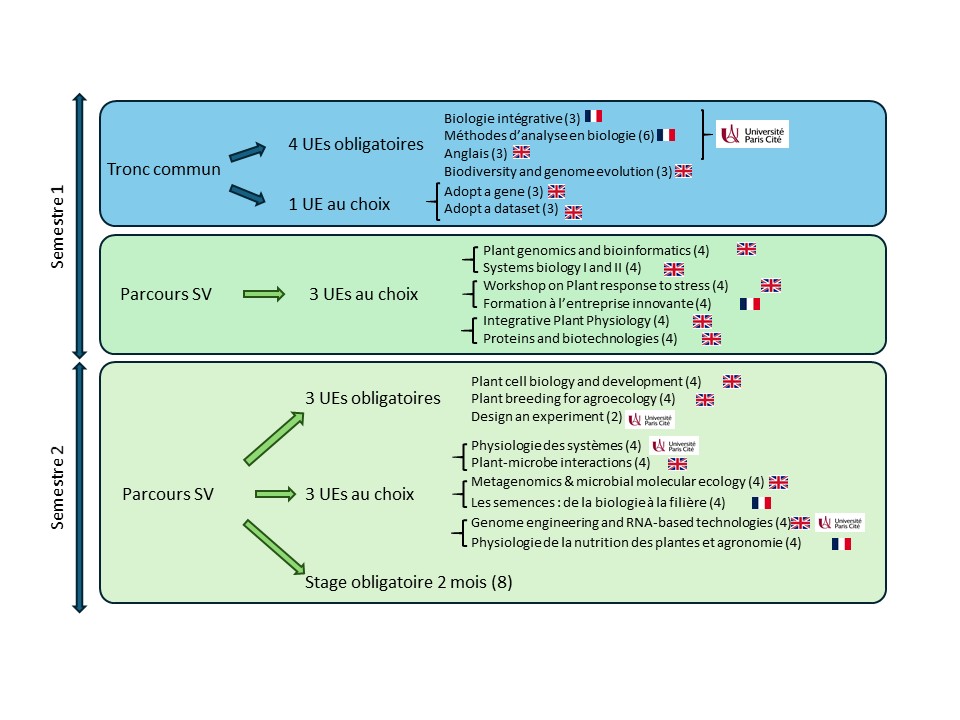
L'organisation du M1
– un tronc commun du master avec des enseignements fondamentaux (biologie intégrative), méthodologiques (bio-statistiques, bio-informatique) et de l’anglais scientifique.
– des UE spécifiques du parcours SV, mutualisées avec l’Université Paris Saclay :
* 2 UE généralistes (Biodiversity and genome evolution et Adopt a gene ou Adopt a database)
* 9 UE dédiées aux plantes, dont, six à choix ce qui permet aux étudiants de se créer un parcours “à la carte”.
.
D'autres atouts de la formation
- un suivi personnalisé des étudiants : un référent enseignant par étudiant, oraux de pré-stages, bilans individuels.
- une pratique régulière de l’anglais scientifique, essentielle aussi bien dans le monde de la recherche que dans les emplois de cadres : enseignement d’anglais (3 ECTS), plusieurs UE à choix en anglais, nombreux rapports et soutenances. En cas de présence d’étudiants non francophones, l’ensemble des supports seront en anglais. Possibilité de réaliser le stage à l’étranger.
- une ouverture vers le monde de l’entreprise : UE de “Formation à l’entreprise innovante”, visites de sites et interventions de professionnels, possibilité de réaliser le stage en entreprise,
- un large réseau de laboratoires et d’entreprises partenaires,
- un stage obligatoire de deux mois minimum en laboratoire ou en entreprise (possibilité à l’étranger avec des offres privilégiées chez des universités européennes partenaires)
Responsables et contacts
Université Paris Paris Cité)
Responsables pédagogiques du parcours SV (M1 et M2) :
Anouck DIET anouck.diet@u-pariscite.fr
Sophie FILLEUR sophie.filleur@u-pariscite.fr
Responsable administrative/scolarité :
Anicette ANON anicette.anon@u-pariscite.fr
UFR Sciences du vivant, Bâtiment Lamarck, 35 rue Hélène Brion, bureau RH42, RdC Haut; 75205 Paris cedex 13 ;
tel : +33 (1) 57 27 82 35
Etablissement partenaire : Université Paris Saclay
Responsables pédagogiques :
Karine Alix (AgroParisTech), Axel de Zélicourt (U. Paris Saclay), Gianluca Teano (U. Evry Val d’Essonne)
Calendrier de l'année
Pré-rentrée du M1 BIP : 31 Août 2026 – tests d’anglais, révisions (BM, génétique, génomique, présence obligatoire)
Début des enseignements du tronc commun: 2 Septembre 2026
Semestre 1
cours : de sept 2026 à mi-janvier 2027 : (tronc commun de 8 semaines puis 3 UE du parcours SV, (2 semaines chacune)
examens de session 1 du TC : mi-Novembre
Semestre 2
cours : de mi-janvier à mi-avril 2027
examens de session 1 : généralement à la fin des UE
stage : de fin Avril à mi-Juin, rapport écrit et soutenance orale en anglais
Lieux des enseignements :
tronc commun à l’Université Paris Cité (site des Grands Moulins ou St Germain)
parcours SV : UE par périodes de 2 semaines sur l’Université de Paris Cité ou de Paris Saclay (Plateau de Saclay)
LES ENSEIGNEMENTS DU M1
Les UEs du tronc commun
semestre 1 : 4 UE obligatoires + 1 UE au choix
S1- Biologie Intégrative (Paris Cité)
Intitulé UE/ECUE: Biologie intégrative (Paris Cité)
Type d’UE/ECUE: Obligatoire, Tronc Commun PAPH & SV
Responsable de l’UE/ECUE : S. Filleur / C. Dugast
Nombre d’ECTS: 3
Lieu , organisation, langue : Paris Cité, Grands Moulins, tronc commun, français
Objectifs en terme de connaissances:
Décrire, expliquer et discuter la relation génotype/fonction,
mécanismes généraux et intégration de réponses aux stress chez les organismes eucaryotes pluricellulaires
Compétences visées:
Communiquer des données scientifiques sous forme d’un poster
Contenu de l’UE/ECUE:
Aspects cellulaires et moléculaires de « problèmes biologiques complexes », illustrés par des exemples issus des règnes animal et végétal : réponses au stress thermique, au stress génotoxique et au stress nutritionnel.
S1- Méthodes d'Analyse en Biologie (Paris Cité)
1 UE au choix à 3 ECTS: Outils informatiques pour biologiste ou Initiation à la programmation Python
| Intitulé UE/ECUE | ECUE Outils informatiques pour biologistes | ECUE Initiation à la programmation Python |
| Type d’UE/ECUE | UE à choix, TC PAPH & SV | UE à choix, TC PAPH & SV |
| Responsables de l’UE/ECUE | D. FLATTERS / L. TAMISIER | I. NICOLIS |
| Nombre d’ECTS | 3 | 3 |
| Langue d’enseignement | Français | Français |
| Lieu de l’enseignement | Paris Cité campus St Pères, tronc commun | Paris Cité campus St Pères, tronc commun |
| Objectifs en terme de connaissances | Choisir et maîtriser les outils adaptés à l’analyse des données expérimentales complexes (bio-analyses) | Introduction à l’algorithmique, notamment boucles et conditions. |
| Compétences visées | organiser un travail en autonomie et en groupe | Mettre en oeuvre les usages avancés et spécialisés des outils numériques |
| Contenu de l’UE/ECUE | • Shell • Analyse et comparaison de séquences biologiques • Graphisme moléculaire • Modélisation par homologie • Réseaux d’interaction • Initiation à la programmation R pour l’analyse de données (3 séances) • Voies métaboliques |
L’enseignement a lieu en salle informatique sous la forme de cours et de séances interactives dirigées qui mettent en pratique les notions abordées en cours. Un mini-projet par petits-groupes est à développer. Les logiciels utilisés sont libres et compatibles multi-plateformes afin que les étudiants puissent les installer pour pratiquer sur leurs ordinateurs personnels. Types de variables en python, y compris listes et dictionnaires. Définition et utilisation de fonctions et d’objets. Utilisation de modules supplémentaires, notamment en bioinformatique et interfaçage graphique. |
S1- Anglais (Paris Cité)
Intitulé UE/ECUE : Anglais (Paris Cité)
Type d’UE/ECUE : Obligatoire, TC PAPH & SV
Responsable de l’UE/ECUE :P. CHOLET
Nombre d’ECTS: 3
Lieu de l’enseignement : Paris Descartes
Objectifs en terme de connaissances : Rédiger et présenter des concepts scientifiques à un public non spécialiste.
Compétences visées: Acquisition du niveau CECR B2
Contenu de l’UE/ECUE: Développement des quatre compétences qui sont l’expression orale, l’expression écrite, la compréhension orale et écrite, compétences ancrées principalement dans le contexte scientifique, dans l’étude de documents authentiques. Pendant le semestre, les étudiants devront travailler leur rigueur grammaticale et lexicale, notamment afin de pouvoir s’exprimer de façon claire et précise, afin de comprendre les nuances auxquelles ils seront exposés. En plus que de l’aspect linguistique, ils seront invités à présenter des exposés, à rédiger des essais qui solliciteront un travail sur la méthodologie de l’argumentation qui peut-être une difficulté majeure en langue.
Course Title: English (Paris Cité)
Course Type: Mandatory, Core Course (PAPH & SV)
Course Director: P. CHOLET
ECTS Credits: 3
Teaching Location: Paris Descartes
Learning Objectives (Knowledge): Draft and present scientific concepts to a non-specialist audience.
Target Competencies: Attainment of the CEFR B2 level.
Course Content: Development of the four core skills: speaking, writing, listening, and reading comprehension, primarily grounded in a scientific context through the study of authentic documents. Throughout the semester, students will work on their grammatical and lexical accuracy in order to express themselves clearly and precisely, as well as to grasp nuanced content. Beyond language mechanics, students will give oral presentations and write essays that require mastering argumentative methodology, which often poses a major challenge in language learning.
S1- Biodiversity and Genome Evolution (Paris Saclay)
Main teaching language: English
Objectives: This module aims to present the notion of biodiversity as a whole, with particular emphasis on its genetic and genomic aspects, giving a prominent place to the fundamentals of population genetics and to understanding the dynamics of genetic evolution within a population. It also focuses on the main mechanisms involved in the structural evolution of genomes and in the dynamics of the regulation of their expression, incorporating the epigenetic mechanisms underlying functional diversity.
Content: Population genetics (15 h): key concepts of population genetics; influence of reproductive systems on genetic diversity; effects of selection and drift on population evolution; the balance between mutation and selection, and cryptic polymorphism; the origin of species diversity and the processes of speciation. Structure and evolution of the eukaryotic genome (4 h 30): major genome components, transposable elements and structural and functional diversity, genome duplication and innovation in species adaptation.
Epigenetics (5 h): chromatin organization (euchromatin, heterochromatin); gene expression (histone modification, DNA methylation); alternative splicing.
Number of ECTS credits: 3 ECTS
Skills to be acquired :
– Be able to solve a population genetics problem
– Explain the epigenetic basis of the regulation of gene expression
– Describe the processes generating diversity in eukaryotic genomes
– Give a concise account of a scientific study and identify the main results and conclusions to be retained, using a mind map
Organization and monitoring arrangements:
Lectures to define new concepts.
Knowledge-application exercises during the lectures; discussion-based tutorials, linked to the lectures, on the concepts covered.
Literature workshop with in-class presentation and discussion, illustrating with examples the notions and concepts covered in the lectures.
Supervised project (2 h 30) based on the analysis of a scientific paper, drawing on the knowledge acquired during the module and using mind mapping to structure thinking and argument for an assessed oral presentation.
Coordinators:
Karine Alix Professor, AgroParisTech (karine.alix@agroparistech.fr)
Pierre Gérard Associate Professor, AgroParisTech (pierre.gerard@agroparistech.fr)
Teaching team:
Moussa Benhamed, Professor, Université Paris Cité; David Latrasse, Associate Professor, Université
Paris-Saclay
S1- UE1 (à choix) : Adopt a gene (Paris Cité) ou Adopt a Dataset (Paris Saclay)
Project ‘Adopt a gene’(Paris Cité) Optional course unit A, option 1 Intended learning outcomes : Illustrate the main methods for studying a gene or a protein (experimental methods and in silico tools). Define a relevant biological question from existing data on a scientific topic. Propose an experimental design. Be able to construct a query using AI tools to produce a summary, and to identify and correct any errors in it. Be able to produce a scientific figure with a caption and explanation, and to present it orally. Number of ECTS credits: 3 ECTS • Produce a synthesis of scientific data Organization and monitoring arrangements : Supervised project – each student is tasked with studying a gene or a protein proposed by a researcher. They carry out a review of the state of the art, perform additional (in silico) analyses, and then identify a relevant biological question. Course organization: Study of an accession (searching bibliographic and biological databases, bioinformatics analyses) – 6 computer-based practical sessions of 2 h Main teaching language: English |
Project ‘Adopt a dataset’(Paris-Saclay) Optional course unit A, option 2 Course content and teaching objectives: During this course, students will be given a data set to analyse in depth. The teaching is based on active pedagogy, accompanied by a scientific tutor who will have his or her own dataset to be analysed. Number of ECTS credits :3 ECTS During this course, students will learn to: Prerequisites :Basics of statistics and bioinformatics Main teaching language: English
|
semestre 2
S2- Stage (2 mois minimum)
- 1 stage obligatoire de 2 mois
- pouvant être prolongé durant la période estivale
Les stages peuvent être réalisés en laboratoire ou en entreprise, en France ou à l’étranger
Les UEs spécifiques du parcours “sciences du végétal”
semestre 1 : 3 UE au choix
S1- UE1 (au choix) Plant genomics and bioinformatics OU Systems biology I and II (Paris Saclay)
|
Plant Genomics and Bioinformatics (Paris-Saclay) Optional course unit B, option 1 |
Systems Biology I & II (Paris-Saclay) Optional course unit B, option 2 |
|
| Objectives | Understand the basic elements and specificities of genomics as applied to cultivated plants. Use the different bioinformatics databases and their characteristics to perform an appropriate search by selecting specific parameters. Understand the specificities of genome evolution in cultivated plants, as well as the natural and artificial processes involved in creating genetic diversity. Explain the principles of long-read sequencing and evaluate its advantages for de novo assembly up to T2T genomes. Describe the concepts of pangenomes and pangenomics. |
System Biology I. Students will see different methods to produce transcriptome, ORFeome, proteome and interactome resources and how to integrate them in modeling approaches to have new insights on cellular processes. System Biology II. In this course, students will explore a number of mathematical approaches to tackle biological issues through the integration of “omics” data. The mathematical approaches include the methods known as constraint-based modeling, i.e. flux balance analysis, resource balance analysis, but also tools specific to the analysis of dynamic systems and Boolean systems. |
| Content | The application of genomics and bioinformatics tools to the study of the genome of cultivated plants will be presented. The specific features of genome structure, such as duplications, transposable elements and multi-genomes, as well as the genome diversity of cultivated plants, including heterozygosity, will be discussed in relation to the evolution of crops and specific agronomic traits. The specificities of organelle genomes will also be presented and discussed. The available genetic and genomic resources will be presented in light of their potential applications. The section on teaching bioinformatics through practical exercises will expand on the concepts of comparative genomics, protein motif research, and structure-function relationships. It will also introduce gene regulatory networks and protein-protein interaction networks, demonstrating how to construct and analyse them for functional annotation. This course provides an overview of the principles of long-read sequencing and its advantages for generating high-quality de novo assemblies, including those of entire genomes from telomere to telomere (T2T). Students will explore methods for evaluating the quality of genome assemblies and discuss their key applications in genomics research. The course will introduce pangenomes and pangenomics, emphasising their role in representing genetic diversity beyond single reference genomes. |
System Biology I. Integrative approaches are key steps in the thorough exploitation of omics data and their translation into knowledge. In this module, students will have courses on the architecture and the machinery of the cell, and on the genome and epigenome organization. They will learn how to combine predictive and experimental approaches to decode the genomic information through the structural and functional annotation of genomes. The integration and the querying of heterogeneous data imply to perfectly know their origin in order to take into consideration their quality, relevance and confidence levels. The understanding of this approach is the basis of holistic analyses for systems biology. System Biology II. Global analyses (omics) currently generate large datasets that do not capture the complexity of living systems. Systems Biology is an approach where omics data are integrated and exploited (compared) through mathematical models of biological systems or sub-systems. The complexity of biological systems and the diversity of issues to be considered require the use of different types of modelling. |
| Number of European credits | 4 | 4 |
| Main teaching language | English | English |
| Skills to be acquired | Explain the importance of high-throughput sequencing and bioinformatics in plant genome analysis, outlining the advantages and limitations of next-generation sequencing techniques. – Describe the main mechanisms of plant genome evolution, such as polyploidy, interspecific hybridization, transposition and structural rearrangements. – Explain the molecular mechanisms involved in creating useful diversity for improving crops. – Know how to use public databases and bioinformatics tool platforms. – Present a scientific study and summarise the main results and conclusions; know how to communicate a scientific message. |
On completion of the course, students will be able to: • Have a good understanding of the challenges posed by integration of omics data. They should be able to understand and summarize a scientific paper in the field. • Understand and explain the challenges of using constraint-based modeling approaches to describe cellular behaviours • Summarize and present a scientific paper in the field. |
| Teaching team | Bénédicte Sturbois (benedicte.sturbois@univ-evry.fr) Karine Alix (karine.alix@agroparistech.fr) |
Matthieu Jules (matthieu.jules@agroparistech.fr) Guillem Rigaill (guillem.rigaill@inrae.fr) Anne Goelzer (anne.goelzer@inrae.fr) |
S1- UE2 (au choix) : Workshop on Plant response to stress OU Formation à l’entreprise innovante (Paris Saclay)
|
Main teaching language :English Objectives: Content: Number of European credits : 4 ECTS Skills to be acquired: Coordinators: |
Enseignement en français Description du contenu de l’enseignement: L’UE a été créée afin de permettre à tout étudiant en Sciences d’appréhender le monde économique et le monde de l’entreprise : après une série de conférences d’Economie générale, le monde de l’entreprise est présenté à travers les grandes fonctions de l’entreprise, de la multinationale à la start-up. Ces enseignements s’appuient sur des enseignants ayant une expérience de création d’entreprise et des professionnels. Objectifs : – Maîtriser les concept clés de l’analyse économique (croissance économique, concurrence, libéralisme, intervention publique) Contenu : Nombre de crédits européens: 4 ECTS Compétences à acquérir: Responsable: Fabrice Lequeux, MCF Université Paris-Saclay (fabrice.lequeux@universite-paris-saclay.fr)
|
S1- UE3 (au choix): Integrative Plant Physiology OU Proteins and biotechnologies (Paris Saclay)
|
Integrative Plant Physiology (Paris-Saclay)
Prerequisites (strongly recommended): Good knowledge of the basics of plant physiology and metabolism. Objectives: Students will acquire theoretical and practical knowledge aimed at furthering their understanding of the flexibility of plant function in a changing and potentially stressful environment. Group-centered bibliographic research projects are focused on key players in metabolic responses to external factors, and involve the preparation of a report in the form of a structured and logical oral presentation. Supervised exercises aim at the acquisition of a more in-depth knowledge of plant biochemistry and molecular biology. Content: The module involves interactive discussions, exercises (including some that involve the preparation Number of European credits: 4 ECTS Skills to be acquired: Coordinators: Teaching language: English
|
Proteins & Biotechnologies (Paris-Saclay)
The program first introduces the major families of alternative proteins (plant-based, insect-derived, microbial), their functional properties, and their prospects for use in food systems. It then addresses the biotechnological approaches involved, ranging from conventional techniques such as mutagenesis, transgenesis and cisgenesis, to new genome editing technologies, as well as the contributions of protein engineering, synthetic biology, and systems biology. Cross-cutting themes, including protein separation, industrial transformation processes, and metabolic pathway engineering, are also explored. Ethical, societal, and regulatory aspects of applying biotechnology to food production are considered throughout. Number of European credits:4 ECTS Skills to be acquired : Assessment in this unit is designed to evaluate a combination of scientific knowledge, analytical ability, and applied problem-solving skills. The written report assesses students’ capacity to synthesise scientific literature, critically appraise biotechnological approaches, and contextualise them within ethical and regulatory frameworks. The oral examination evaluates students’ ability to communicate complex scientific concepts clearly, defend arguments, and demonstrate integrative understanding across molecular, physiological, and technological dimensions. The written Coordinators: Main teaching language: English |
semestre 2 : 3 UE obligatoires + 3 UE au choix
S2- Plant cell biology and development (Paris Saclay)
Main teaching language: English
Objectives: The aim of this course is to understand and master key concepts in plant developmental biology at the molecular, cellular and whole-organism levels. The topics covered, whether in model or cultivated plant species, will concern the major stages of plant life and morphogenesis, responses to environmental changes, natural diversity and variation, and some aspects of Evo-Devo. This knowledge can be re-used to explore new themes in future courses, whether or not they focus on the study of development.
Content: The course unit will include a component of traditional teaching (lectures, tutorials and practical sessions), sessions focused on debate and the formulation of questions, as well as a series of presentations during which students will be invited to present and discuss analytical techniques and lab methods.
The teaching unit is divided into 3 learning and thematic blocks:
• What is a plant cell and what is plant development?
• How to study plant development?
• How developmental knowledge can be useful?
Number of European credits: 4 ECTS
Skills to be acquired:
The assessment will focus on the ability to integrate theoretical information, data analysis and bibliographic references presented in the form of presentations and written reports.
Coordinator:
Marianne Delarue Professor : marianne.delarue@universite-paris-saclay.fr
S2- Plant breeding for agroecology (Paris Saclay)
Main teaching language : English / French
Objectives :
– Consolidate the genetic foundations underlying the processes of evolution and of population
structuring in a plant breeding context
– Know the genetic basis of quantitative traits
– Implement a QTL detection approach
Content
• Population genetics (linkage disequilibrium, genetic drift and population evolution)
• Crossing designs and genetic mapping
• Mechanisms of genome evolution
• Introduction to quantitative genetics and methods for studying complex traits, including
resistance and adaptation traits
• The genetic basis of the domestication of cultivated plants
• Genetic resources and their value in plant breeding
Number of ECTS credits : 4 ECTS
Skills to be acquired :
– Know the principles governing the evolution of the genetic structure of a population
– Be able to explain what a quantitative trait is
– Know the methods used to characterize the genetic basis of a quantitative trait
– Be able to explain what genetic resources are, the forms in which they exist and how to use them in
plant breeding
– Be able to explain the importance of genetic diversity in a plant breeding program
– Implement a QTL detection approach
– Carry out a DNA extraction and genotyping using SSR markers
Coordinator:
Sarah Ben Sadoun : sarah.ben-sadoun@agroparistech.fr
S2- Design an experiment (Paris Cité)
Main language of teaching : English
Objectives:
• Training to conduct experiments
• Designing and carrying out a biological experiment independently
Content:
Lectures: experimental methods, characteristics of a scientific experiment
Tutorials: designing an experiment to validate results obtained using a -‘omics’ approach
Practical course: carrying out the experiment (in a specific laboratory, during a practical session)
Number of European credits : 2,5 ECTS
Skills to be acquired :
– work as part of a team
– design and carry out a relevant experiment to answer a specific biological question
– critically analyse a methodology and data
Coordinators :
Christine Lelandais : christine.lelandais@u-pariscite.fr
Sophie Piquerez : sophie.piquerez@universite-paris-saclay.fr
S2- UE1 (à choix) : Physiologie des systèmes (Paris Cité) OU Plant-microbe interactions (Paris Saclay)
|
Physiologie des Systèmes (Paris Cité)
Enseignement: français/ anglais Type d’UE/ECUE UE à choix : parcours PAPH et SV Objectifs: Compétences visées: Intégrer et synthétiser des informations, argumenter pour défendre une hypothèse. Contenu de l’UE/ECUE : L’UE sera axée sur les communications/coopérations entre différents organes / systèmes pour une fonction biologique. L’accent sera mis sur l’intégration des données permettant de modéliser ces processus complexes. Les exemples seront issus des règnes animal et végétal : stratégies métaboliques en lien avec le développement et l’adaptation, interactions avec le microbiote, rythmes biologiques par exemple.
|
Plant-microbe interactions (Paris-Saclay)
Main teaching language : English Objectives: Number of ECTS credits : 4 ECTS Skills to be acquired : Coordinator: |
S2- UE2 (à choix) : Metagenomics & microbial molecular ecology OU Les semences : de la biologie à la filière (Paris Saclay)
|
Metagenomics and microbial molecular ecology
Main teaching language : English Knowledge and implementation of molecular and bioinformatic tools for the analysis of microbial ecosystems using metagenetic approaches (e.g. 16S gene amplicon sequencing; or other markers depending on the microbial ecosystem studied). Knowledge of the principles of descriptive and functional microbial ecology. The course will aim to compare several samples taken either from a food microbial ecosystem, from environmental microbiota or plant, human or animal digestive microbiota, or from biotechnological digesters used to treat bio-waste. Descriptive and functional knowledge of these ecosystems will be presented in lectures, and the acquisition of the skills necessary for data processing will be addressed in tutorials and practicals. Emphasis will be placed on the critical study of the different stages of analysis using bioinformatics tools that are easy for microbiologists to use and implemented on a Galaxy interface or R biostatistics packages specific to Prerequisites: Basic knowledge in microbial taxonomy, in biostatistics and in the use of R language Number of European credits : 4 ECTS Skills to be acquired: Coordinators:
|
Les semences : de la biologie à la filière (Paris-Saclay)
Langue principale d’enseignement : Français Objectifs : Contenu : Nombre de crédits européens : 4 ECTS Compétences à acquérir : Coordinateur:
|
S2- UE3 (à choix) : Genome engineering and RNA interference (Paris Cité) OU Physiologie de la nutrition et agronomie (Paris Saclay)
|
Genome engineering and RNA interference (Paris Cité) Main teaching langage: English Objectives: Content: Number of European credits : 4 ECTS Skills to be acquired: Coordinators : |
Physiologie de la nutrition et agronomie (Paris-Saclay) Langue principale d’enseignement : Français Prérequis : Objectifs : Contenu : Nombre de crédits européens : 4 ECTS Compétences à acquérir : Coordinatrices : |